
In the past few posts we’ve discussed how to address Sovereignty as a risk, what the trade-offs are and now its the “why can’t we build this ourselves” chapter. This is more of an economic background chapter.. but the next post (4) will be about mitigations..
History of hyperscale
Hyperscale did not appear overnight. It is the result of several decades of evolution in how we build, operate, and think about computing systems. It was during the dot-com era in the late 1990s that the term “hyperscale” first started to appear. It described a new kind of infrastructure: data centers that could scale horizontally by adding large numbers of commodity servers, rather than relying on a few powerful machines. This was a fundamental shift. Instead of engineering perfection into each individual system, the focus moved toward designing systems that could fail, recover, and expand continuously. But the real acceleration happened in the early 2000s. Companies like Amazon, Google, and Microsoft built globally distributed platforms to support millions of users and enormous data volumes. When AWS launched in 2006, followed by Azure and Google Cloud, this internal capability became available to everyone
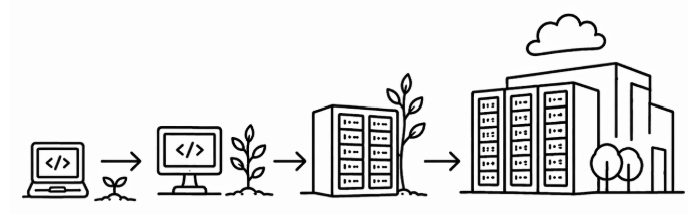
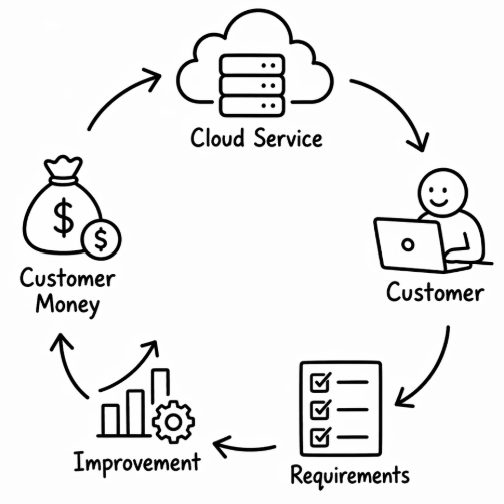
Since then, hyperscale has evolved into something much broader than infrastructure. It’s a model where hardware, software, operations, and security are tightly integrated and continuously optimized at global scale. That evolution is not accidental. It is driven by continuous customer demand (new features, stronger security, deeper integration) amplified by the scale of the platforms and the investment that comes with it. The larger the ecosystem becomes, the more it fuels its own pace of improvement funded by the customers using it.
Today, that same model is pushing into AI, specialized hardware, and entirely new forms of computing, extending the idea of hyperscale beyond data centers into the foundation of the digital economy.
Can Europe build a hyperscaler?
At a high level, the answer is simple: yes, it is technically possible.
There is no single proprietary technology that prevents it. The underlying components (compute, networking, storage, software) are widely understood and available. Europe has strong engineering talent, established hosters, and a growing ecosystem of cloud and infrastructure providers.
So the question is not whether it can be built, it is what would it actually take?
One of the common misunderstandings is treating hyperscale as if it were a product that can be replicated: buy some hardware, install some software, and you’re done.
In reality, it’s something entirely different.
Hyperscale is the result of decades of compounding investment and learning. It is built on tightly integrated systems spanning custom-designed hardware, software, security models, operational processes, and supply chains. These layers are not independent, they continuously evolve together.
What makes this model powerful is the feedback loop. Large-scale usage drives continuous improvement. Real-world demand shapes features, security, and integration. And the size of the customer base provides the economic engine to fund that evolution while still delivering a possible return.
So it’s not just infrastructure.
It’s an ecosystem that learns, adapts, and reinvests at scale.
And that is significantly harder to replicate than simply assembling the individual components.
US hyperscalers piggy back off decades of investments – being able to gradually grow the ecosystem to what it is today, a new hyperscaler would require massive upfront investments, a large set of customers or prospects that are willing to immediately use it (and pay for it) so it is immediately utilized at a significant level.
The economics in hyperscale / digital IT are relentless. Hyperscalers operate on a capital-intensive model where the majority of costs are incurred upfront (think land, power infrastructure, buildings, cooling, and increasingly hardware itself) often representing billions of dollars before a single workload is deployed. These are largely fixed costs, and only become economically viable when spread across high and sustained utilization.
Utilization, therefore, is not an optimization parameter, it is the core economic driver. A facility operating at 50% utilization is not “half efficient”; it is structurally uneconomic, as the same capital base must be amortized over half the revenue. This is why occupancy rates in mature hyperscale markets trend toward very high levels, often exceeding 85–95% under strong demand conditions
The third pillar is service catalog breadth. Hyperscalers operate thousands of services supported by deeply specialized engineering, operations, and security teams. These are not optional capabilities, they are embedded, always-on, and continuously evolving.
The cost of delivering this does not scale linearly. Security operations, monitoring, and compliance require highly skilled teams and global coverage. Hyperscalers amortize these fixed costs across a vast hardware estate and customer base, lowering the unit cost significantly.
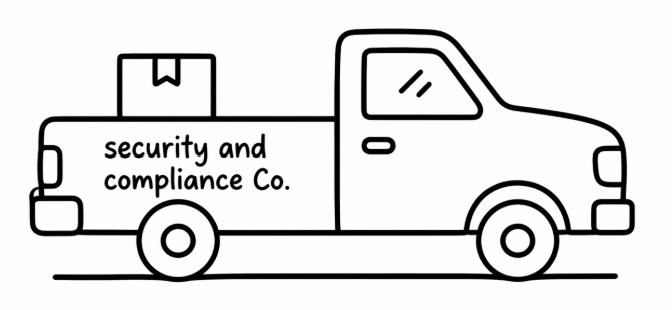
At the same time, hyperscalers benefit from compounding effects, shared telemetry, cross-service integration, and continuous learning across their entire platform. New entrants lack this feedback loop, making it difficult to match both the breadth and maturity of hyperscale services.
For a new entrant security and resilience are non-negotiable from day one, but must be delivered over a much smaller capacity and customer base. This drives significantly higher per-unit costs and reduces competitiveness from the start.
So lets build it
So what do we actually require to build a new European hyperscaler quickly that can compete with US tech?
- Massive upfront capital to build capacity that has no immediate guarantee of demand
- A large, committed customer base willing to adopt early and sustain high utilization
- Deep expertise and integrated capabilities across hardware, software, security, and operations from day one
But more fundamentally, it requires something harder to manufacture:
- Time: to iterate, learn, and refine at scale
- Demand continuity: to keep the system economically viable while it evolves
- Feedback loops: to continuously improve based on real-world usage
A common counter-argument is that hyperscale can be built gradually; if enough European customers move to sovereign providers, scale will emerge over time.
In practice, this overlooks the timing problem. Gradual growth means prolonged periods of low utilization, limited services, and higher costs. During that phase, the platform is neither competitive nor complete, yet customers expect both from day one. You need scale or conviction to attract demand, and you need demand (in service portfolio) to actually scale. And this does not change the economics of cybersecurity. Security and resilience are non-negotiable, you cannot defer them by focusing on smaller workloads. The full capability must be in place from the start, with all associated costs, regardless of scale – certainly if we are going to host Europe’s most critical data and services on it.
Fragmentation
So the economics show that this model is only viable at scale. It requires a large, concentrated demand base. Which requires us to take a look at how Europe exists today. The USA and China are large, unified markets with a significant number of customers willing to consume and pay for cloud services at scale.

Europe, while larger in population, is structurally different. It consists of multiple independent nations, each with its own regulatory frameworks, priorities, and levels of trust. Which raises a fundamental question: would these nations accept a single hyperscaler operating across the entire continent, or would they prefer to keep their most critical systems within national providers? The next question we’d have to answer as well, is how many of these European customers have an international business with ties to the USA but would require a pure-European hoster?
If demand fragments along national lines, so does utilization. And if utilization fragments, the economic model becomes significantly harder to sustain. This pressure increases further if the addressable customer base is further reduced, whether due to jurisdictional concerns, regulatory constraints, or exposure to foreign sanctions in combination with the desire/need to innovate rapidly on an ever growing AI foundation.
In short, most customers demanding pure sovereign services are public sector and critical infrastructure organizations within Europe. By nature, these tend to prefer national providers rather than a single pan-European platform.
At the same time, internationally operating companies benefit less from a purely European hyperscaler, which significantly reduces the addressable customer base. In practice, this leaves a relatively small subset of customers to sustain the model.
Critically, this does not change the economics of cybersecurity, operational excellence, performance demands and innovation.
The question then becomes simple, but uncomfortable:
Does Europe consider sovereignty important enough to fund it?
Funding
Europe has awarded millions in an effort to boost European’s Digital Economy. There is growing recognition that, structurally, Europe fell behind the United States and China in the development of (hyperscale) digital platforms. Over the past two decades, both regions have produced technology ecosystems centered around large, vertically integrated hyperscalers that now dominate global cloud infrastructure, AI, and data services.
Europe, by contrast, has traditionally focused on regulation, interoperability, and open markets, rather than concentrated platform investment. The result is a highly capable but fragmented ecosystem, without a native hyperscaler operating at global scale.
In response, Europe has launched a range of initiatives aimed at strengthening digital sovereignty and building local capability. These include funding programs, regulatory frameworks, and coordinated efforts such as sovereign cloud initiatives, data infrastructure projects, and industry collaborations. Investment in sovereign cloud infrastructure is growing rapidly, with spending expected to increase significantly in the coming years. So let’s take a closer look at those efforts because while the direction is clear, the scale and structure of these investments are fundamentally different from those that created hyperscalers over the past 20 years.
Within these investments, it is important to understand, that even funding with millions of Euro’s, the foundational cyber security requirements do not change. The dependency on foreign hardware, firmware and operations do not change, and that even most open-source is still subjected to foreign dependencies, trade agreements and upstream supply chains.
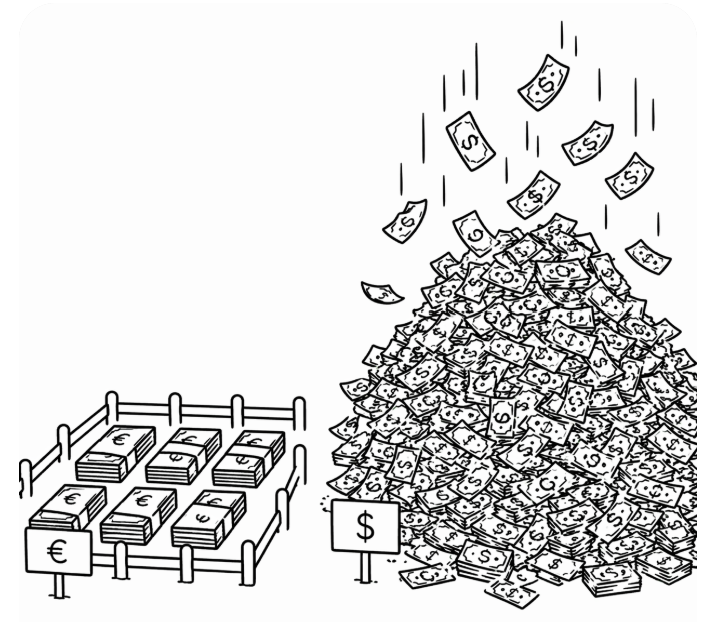
Hyperscalers are investing at unprecedented levels. In 2026 alone, the largest US hyperscalers are expected to spend between $600–700 billion in capital expenditure, primarily on datacenters, hardware, and AI infrastructure. These are not one-off investments, but sustained, compounding cycles that build on decades of prior expansion.
Globally, the required investment to meet growing compute demand is projected to reach nearly $7 trillion by 2030. Hyperscalers are not reacting to this demand, they are actively shaping it through continuous capacity expansion and innovation.
By contrast, European sovereign cloud investments operate at a very different scale. Even high-profile initiatives are measured in the hundreds of millions, for example: A €180 million EU sovereign cloud program. However, this funding is distributed across multiple providers over several years, translating into only a few million per year per participant.
Broader European sovereign cloud spending is growing, with projections of around $12.6 billion in 2026, but this remains an order of magnitude smaller than hyperscaler capital deployment.
This gap matters because hyperscale capability emerges from cumulative investment and sustained demand from paying customers. Each generation of infrastructure lowers cost, expands services, and improves utilization across the entire platform.
European initiatives, by comparison, are primarily focused on establishing sovereignty-compliant capability, rather than continuously out-investing incumbents at scale. At the same time, they often lack a clearly defined and committed customer base willing to fully adopt and fund these platforms, despite their lower maturity, reduced integration, and potentially higher cost.
That’s it?
All of this leads to the uncomfortable question:
Are we inevitably dependent on US hyperscalers?
In practice, the answer today is largely yes.
Anyone arguing otherwise underestimates the structural realities of hyperscale.
This is not due to a lack of capability or ambition in Europe, but because the conditions required to build and sustain hyperscale are not currently present.
Hyperscale requires three things at once:
- sustained, concentrated capital investment
- a large and continuous customer base willing to adopt and pay
- a feedback loop that drives rapid innovation and efficiency gains
Those conditions are tightly coupled and difficult to replicate in a fragmented environment as Europe, where national interests are set above Europe’s shared vision.
Alternative approaches do exist. Europe can move toward more sovereign architectures by leveraging local providers, national hosters, or federated models. However, these come with structural trade-offs that must be understood and accepted: reduced service breadth, higher costs, lower integration, slower innovation cycles, and, ultimately, a continued dependency on underlying US technology.

Public funding can help to bootstrap such initiatives. It can accelerate early development, de-risk initial investments, and create a foundation for sovereign capabilities. But it does not replace the underlying economics. A hyperscale platform requires continuous reinvestment, driven by sustained demand and competitive market dynamics. Public funding, by itself, cannot create a self-sustaining, economically healthy ecosystem.
Intro: Digital Sovereignty
Chapter 1. Sovereignty Risks
Chapter 2. Hyperscale advantages
Chapter 3. Sovereign Europe
Chapter 4. Mitigating risks
Chapter 5. Conversations
Chapter 6. Terms and Conditions
Chapter 7. Ai to aiaiai