
I deliberately moved this chapter to the end; not because AI is less important, but because it is often treated as the starting point in sovereignty discussions. In reality, it sits on top of everything we’ve already covered. AI is frequently used as the primary argument by hyperscalers, and in many conversations it becomes the focal point for discussions (alongside email). The real challenge is not just the models themselves, nor the fact that they can’t be run elsewhere. Technically, many of these capabilities can be deployed in controlled environments, massive investments are already creating ai factories around the world, no, the difference lies elsewhere.
It’s economics.
Training, operating, and continuously improving AI systems requires enormous amounts of data, compute, and feedback alongside investments. That scale is what enables these systems to evolve, and that scale is difficult to replicate in localized environments or within isolated infrastructures. This is why setting the broader context was necessary first, because AI is not introducing a new trade-offs, it is exposing the existing ones more clearly and highly exponentially.
At the same time, AI changes the nature of how data is perceived. With traditional workloads, data is stored, processed, and transmitted. With AI, it is interacted with: Queries are made, responses are generated, and patterns are inferred. That creates a different level of sensitivity, as now you don’t only have the data, you see in which context it is actually being used. And that makes the “where is my data stored?” question obsolete. It becomes: what happens to my interactions, my prompts, my intent, and the outputs I receive?
This is where the concern intensifies but not because the risks are fundamentally new, but because the visibility and perceived value of the used data increases. The idea that queries could be observed, or that responses could be influenced, creates a stronger emotional reaction than earlier sovereignty concerns around storage or infrastructure. Which leads me to another question: Even when processing happens within a region, the systems, models, and operational practices behind it are often globally developed, maintained, and governed. The engineers, the processes, and the dependencies are not bound by geography in the same way infrastructure might be. For very large systems, these queries are (often) distributed across the globe, but even in localized systems, managed by centralized teams. In short, why are we so afraid of running a query outside of our country, when that query is run on a platform, managed by the same people under different jurisdictions? It’s not that location equals less visibility… it’s not that a European instance of Gemini will provide a different view or differently biased output.. (so a personal question, why was everyone so upset when “flexible routing” was enabled?). Secondly, data is the foundation of every interaction you have with a model. The quality of the output is directly tied to how that data is secured, governed, and prepared. Without that, you’re not getting “AI”, you just get unpredictable results. And as these models mature and take on more responsibility, AI governance becomes critical. It’s not just about generating answers, but about ensuring those answers are accurate, authorized, and compliant with how your organization handles data. And this is where the misconception often sits.
Just hosting an LLM does not magically provide governance. AI depends heavily on everything around it: data pipelines, classification, tagging, access control, formats, lifecycle management. Without that discipline, the model is only as good( and safe) as the weakest part of that chain.
Which brings us back to a familiar pattern.
AI does not fundamentally change the nature of sovereignty. It amplifies it by making the dependencies more visible, the trade-offs more tangible, and the questions harder to ignore. AI is not the GPU. It’s the entire data ecosystem behind it consisting of pipelines, governance, security and integration. That’s the real foundation, and that’s where hyperscale platforms make the difference. What was previously an architectural discussion becomes much more immediate, because the interaction is direct and continuous. The economic side is also enhanced in visibility. Every country wants their own “sovereign ai factory” and even Europe is now investing millions into ai infrastructure, trying to build their own capability (although funny enough) based on US technologies.

And yet, just like with everything before, the answer is not binary.
Yes, you can run AI locally; control the model, isolate the data, train it yourself; but AI doesn’t live in isolation, you will need the entire ecosystem around it: pipelines, governance, security, integration, etc. And that’s where the real trade-offs show up again: complexity, security, governance, scale, and the cost of keeping up with innovation.
So let’s dive in a bit more…
The cost of AI
The scale of investment behind AI is hard to comprehend until you look at the numbers. Hyperscalers are no longer experimenting with AI, they are restructuring their entire business around it. Estimates for 2026 place total capital expenditure across the largest players somewhere between 700 and 750 billion dollars, with the majority of that directly tied to AI infrastructure such as GPUs, data centers, and power contracts. Individual companies are committing amounts that would have seemed unthinkable just a few years ago, with Amazon planning around 200 billion and Microsoft close to 190 billion in a single year alone. This is not incremental investment. It is an industrial-scale buildout which is driven by a simple reality: AI is not cheap infrastructure – and the demand for it is soaring.
A single high-end GPU can cost between 30,000 and 40,000 dollars, and that is just the starting point. Once you add highly specialized networking, storage, cooling, and power, the cost of running a cluster rises quickly into the millions. These systems have an economic lifetime of roughly three to five years, sometimes stretched to six in accounting terms, but with new architectures arriving every 18 to 24 months, the pressure to upgrade is constant. That creates a very unforgiving economic model. You are investing heavily in assets that depreciate quickly, consume large amounts of power, and require constant renewal. It means taking a gamble on the actual utilization of the just purchased infrastructure, that requires an ROI within those 18 to 24 months.
Unlike traditional IT infrastructure, GPU economics are brutally simple. The cost is largely fixed the moment you buy or reserve the hardware. Whether the GPU is used or idle, the depreciation, power, and operational costs continue. This means that every unused hour is not just wasted capacity, it is direct financial loss.
And that loss doesn’t start when the first workload runs, it starts the moment the hardware exists. The time between delivery, racking, configuring, and actually running workloads is already a period of zero utilization with full cost. Every delay in getting to production directly increases the effective cost of the system.
This is exactly where hyperscalers have optimized aggressively. Time-to-production is reduced to an absolute minimum, because at scale, even small delays translate into significant financial impact. Once running, utilization becomes the next multiplier. A system at 80 percent utilization carries 20 percent idle cost. At 40 percent utilization, that idle portion jumps to 60 percent. The result is that the cost per unit of useful work can be close to double, even though the hardware and energy footprint remain the same. This in contract with CPU based systems, where power (and equivalent cooling) utilization is more directly in relation with the actual usage, or you can switch them off easily when not in use. You don’t pay for GPUs when they run, you pay for the entire ecosystem when they exist. Everything else is a question of how fast you bring them into production and how effectively you keep them utilized.

Many organizations struggle to push utilization beyond 30 to 50 percent, with some reporting even lower figures, meaning that a significant portion of their investment is sitting idle. In extreme cases, studies have shown utilization levels as low as single digits, turning infrastructure into sunk cost rather than productive compute.
This is where hyperscalers (including all the jurisdictional / sovereign problems) come into play. They are not just large infrastructure providers, as we’ve seen they are operating at a global scale that fundamentally changes the economics foundationally. By aggregating demand across regions, they can continuously shift workloads to where capacity is available. When Europe slows down, those clusters serve the US. When the US slows down, Asia and Europe take over. Workloads don’t stop – they move across the globe.
That creates a follow-the-sun utilization model, where this very expensive but short-lived GPU infrastructure is kept running continuously across time zones. Workloads shift globally, keeping utilization high and allowing the investment to be amortized over a much larger volume of actual usage. Without that continuous demand, the economics break down quickly.
You can absolutely build your own AI stack, use open-source communities to help thrive innovation and run these models locally, within your own jurisdiction, fully controlled. But the moment you do, you inherit the full economic burden: You need enough constant demand to keep expensive infrastructure utilized, or write if off sooner at greater losses or risk falling behind in the innovation curve as the world around you deploys new hardware faster and more efficiently.
When looking at national or European AI factories, the same principles still apply: Aggregating demand across multiple organizations can improve utilization, but it does not fundamentally change the operating model. Unlike hyperscalers, these environments remain largely bound to a single region and its demand patterns.
While workloads can be shared across customers, demand still follows local behavior. Evenings are quieter, weekends see reduced activity, and there are natural peaks and troughs that are difficult to smooth out. The follow-the-sun model simply doesn’t apply at a regional level. And as a result, overall utilization tends to be lower, and the economic model becomes harder to sustain, expensive infrastructure sits idle more often, and the return on investment starts to diverge from what hyperscalers can achieve with globally distributed workloads.
This is the reality that force local or European hosters to operating under a different economic model. They can choose to increase prices to compensate for lower utilization, accept lower profit margins, or rely on continued investment and support from governments to remain competitive. None of those options are inherently wrong, but each comes with its own constraints and none are sustainable.
At the same time, they often operate on longer investment and refresh cycles. Infrastructure is updated less frequently, not because it’s not needed, but because the economics require more careful timing of those investments. It is not a question of capability: It is a question of how the economics of scale, utilization, and investment shape what is sustainable, and what is not.
New models, new capabilities
That same global infrastructure introduces another advantage: continuous improvement and learning. You see, it is not just about serving workloads. It is about optimizing them: Models are trained, refined, and validated across massive, globally distributed capacity. Newer, more capable models emerge frequently, not simply because of better algorithms, but also because they can be trained and tuned at a scale that is difficult to replicate elsewhere.
At the same time, this is not a one-directional story. There is a strong push toward smaller, more focused models that require less compute and can operate closer to the edge. In many cases, constrained environments force innovation in a different direction, more efficient architectures, smarter use of resources, and less reliance on raw GPU scale.
But that doesn’t remove the importance of large-scale models. The innovation happening at the high end, training increasingly capable and general models, continues to set the pace for the entire ecosystem. Those advancements often cascade downward, influencing how smaller, more efficient models are designed and deployed. These larger models feed the system, they demand faster, newer, more capable GPU infrastructure, which in turn enables the next generation to demand even more. Hardware drives models, models drive hardware, and the cycle keeps accelerating at a faster pace.
Which brings us back to the same pattern.
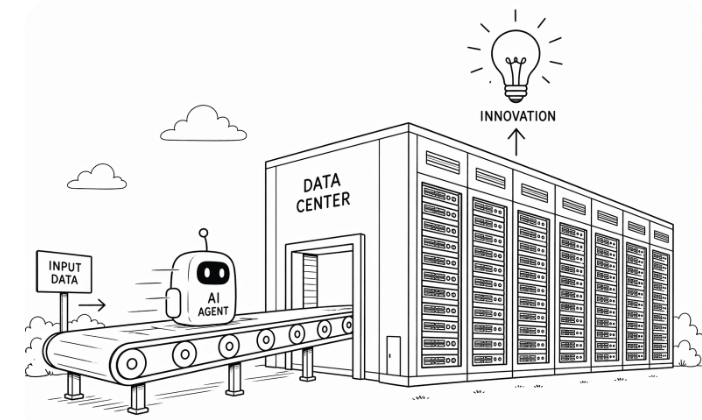
Different approaches exist, and each drives innovation in its own way. But the ability to continuously train, improve, and operate at global scale remains a defining advantage, one that is difficult to replicate without the same level of infrastructure, investment, and demand aggregation. At the same time, that advantage comes at a cost. It requires continuous capital injection, rapid return on investment (if at all), and constant refresh cycles to keep up with the pace of hardware and model evolution.
And that brings us back to a familiar pattern.
Sovereignty risks and their trade-offs are just as present here: Do you choose smaller, more controlled models? Do you accept a slower pace of innovation? Do you extend hardware lifecycles and reduce refresh cycles? Do you take on additional operational complexity?
For me, the critical factor is not strictly where the processing happens. Location by itself does not define control. What matters more is who operates these systems, under which jurisdiction they fall, and, ultimately, the level of trust you place in that model versus the benefits you derive from it. There is no single right answer, but each of these decisions shifts the balance: Between between sovereignty – control, capability, and competitiveness.
The battlefield
I don’t like war examples, as they reference the worst in human kind, but military conflicts force us to become very creative and with the required funding you quickly see what we are capable of (in good and bad).
Warfare has evolved to include the digital domain, supported by data and increasingly by AI, the physical battlefield has changed just as dramatically. It means we need to improve our security services to protect our digital infrastructure but it also implies also that modern conflicts are no longer defined purely by firepower or numbers. They are shaped by speed, coordination, and the ability to process and act on information in real time. Intelligence, targeting, logistics, and decision-making are becoming deeply integrated, creating systems that adapt faster than traditional approaches can respond.
Like it or not, AI plays a growing role in that shift.
Not because it replaces everything, but because it enhances everything. It augments decision-making, accelerates response times, and connects capabilities across domains. And that creates a new reality: staying behind is not neutral, it comes at a cost we usually cannot afford.

Because while adopting new technologies may feel like a choice, in practice, it often isn’t. If one side moves faster, integrates better, and leverages data more effectively, the gap widens quickly. What used to take days or hours can now happen in seconds. What used to rely on human coordination now operates as a system. It forces you to adapt, not because you want to, but because the alternative is losing relevance, capability, or position.
And this is where the tension we have been discussing becomes unavoidable.
On one side, there are hyperscalers operating at a scale of investment, speed, and global integration that is difficult (if not impossible) for individual nations or even regions to match. On the other side, there is the absolute need to reduce dependency, aligning with local values, and maintaining control over how and where systems operate.
In practice, that creates a hard reality.
You are choosing between dependence on external ecosystems and jurisdictions, or committing to a level of investment, coordination, and sustained effort to build alternatives that may never reach the same scale or pace of innovation. Not because of lack of capability, but because of the economics behind it.
Closing thoughts
After everything discussed, risk, jurisdiction, architecture, trade-offs, and now AI, one thing becomes clear: there is no “safe” option. Every choice introduces dependencies. Every control shifts risk somewhere else. Sovereignty is not something you achieve; it is something you continuously balance.
What this journey shows is that most discussions start with technology, but they rarely end there. They become questions about economics, about operating models, and ultimately about trust. Not trust in a feature, or in a location, but trust in the systems, the people behind them, and the structures that govern them.
AI makes this reality harder to ignore. It brings the interaction closer, the data more contextual, and the dependencies more visible. What used to be abstract decisions around infrastructure now directly affect how organizations operate, innovate, and compete. And while there are more options than ever (local models, sovereign platforms, open alternatives) the underlying trade-offs have not disappeared. They have simply become more explicit as the sovereignty risks became more visible.
Despite many opinions this is not a question of right or wrong.
It is a question of priorities.
Do you optimize for control, or for capability? For alignment, or for speed? For independence, or for scale? Every organization will answer these questions differently, based on its context, its risk tolerance, and its ambitions.
For me, one thing stands out. Location alone is not control. Technology alone is not sovereignty. What matters is understanding the system you operate in (who governs it, how do they behave, and what happens when things don’t go as expected?). That is where risk becomes real, and where decisions need to be grounded in more than assumptions or simplified narratives.
The landscape will evolve. More options will emerge. Capabilities will become more distributed. But the fundamental tension remains.
You are not choosing between safe and unsafe.
You are choosing between different combinations of risk, control, cost, and innovation, and accepting the consequences that come with that choice.
Intro: Digital Sovereignty
Chapter 1. Sovereignty Risks
Chapter 2. Hyperscale advantages
Chapter 3. Sovereign Europe
Chapter 4. Mitigating risks
Chapter 5. Conversations
Chapter 6. Terms and Conditions
Chapter 7. Ai to aiaiai